
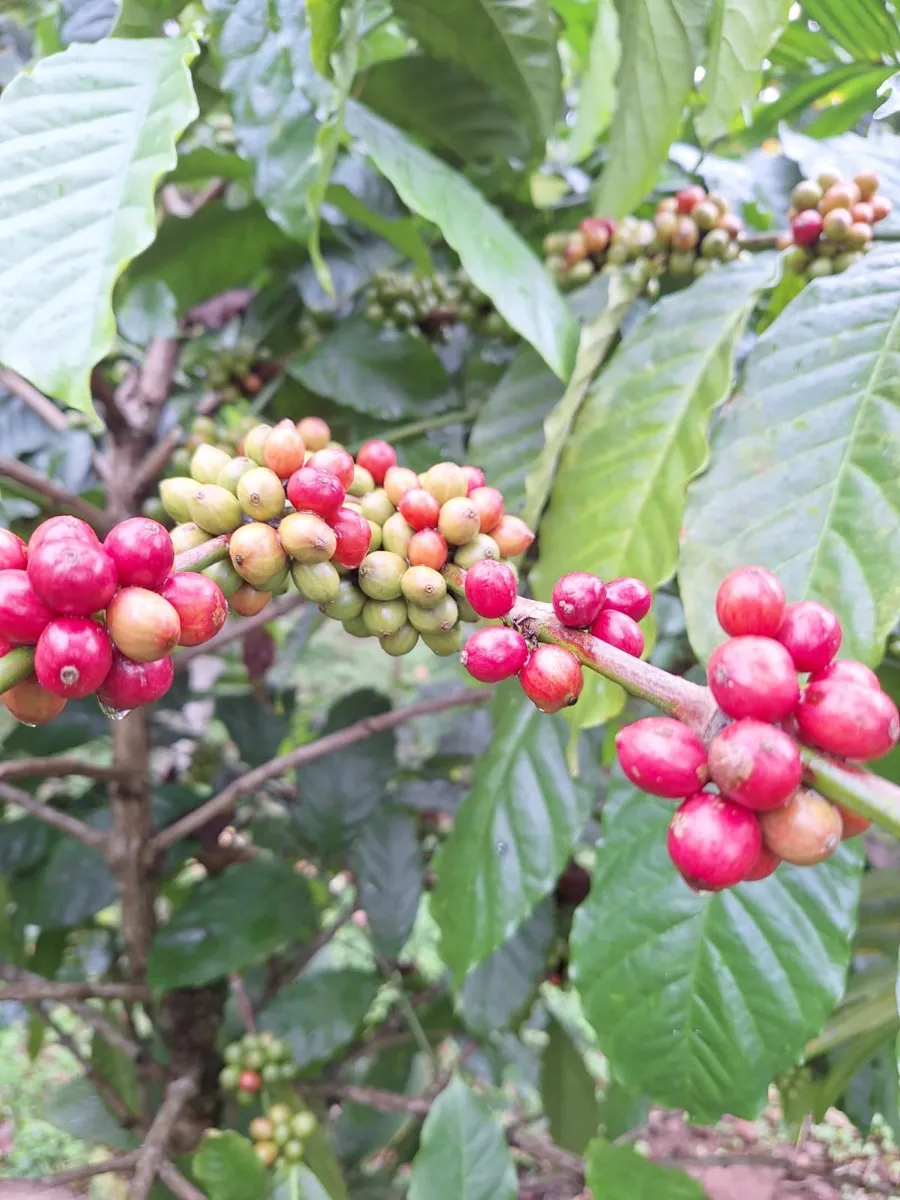
Coffee, pepper and cardamom are more than backdrop in Wayanad. A lot of local families, including ours, depend on them for a living. Visiting the trails properly means treating them as someone's livelihood, not just a photo opportunity.
How Much Coffee We're Talking About
Most visitors register the plantations as scenery. The numbers make the case better than the view does. Coffee covers around 67,000 hectares in Wayanad (about a third of everything cultivated in the district), and the district accounts for roughly 90 per cent of Kerala's coffee.
It is overwhelmingly robusta. Arabica exists here, but robusta is more than 95 per cent of what's grown, and it does well at these elevations, anywhere between roughly 700 and 2,100 metres. Wayanad Robusta received a Geographical Indication tag in 2019, which is the formal way of saying the coffee from these particular hills is recognised as its own thing.
There's a stubborn idea that robusta is simply the cheap coffee. Grown well and in shade, it isn't. Wayanad robusta is usually described as full-bodied and heavily aromatic with a suggestion of chocolate: a different cup from an arabica, not a worse one.
Why It Doesn't Look Like a Farm
The first thing that surprises people walking into a Wayanad plantation is that it doesn't look cultivated at all. There are no rows marching off to a horizon. It looks like slightly tidy forest.
That's because almost none of it is a single crop. Coffee grows under shade trees: rosewood and artocarpus traditionally, and increasingly silver oak. Pepper vines are trained up those same trunks, so one tree is doing two jobs. Arecanut and banana fill in between, providing more shade and another income. Cardamom sits higher and cooler.
None of that is decorative. Mixed planting spreads the risk across crops that fail in different years, keeps pest pressure down without leaning on chemicals, and holds soil on a slope. It's the same reasoning behind the zero-cost organic approach on our own farm. Ask about it and someone here will happily walk you through the whole hillside.
Most of this land is held by small and marginal farmers. Not estates, just families on a few acres each.
The Year, If You Want to Time a Visit
Coffee runs on a fairly fixed calendar here. Flower buds form and blossom through roughly January to April, triggered by the first pre-monsoon showers. Cherries then develop and fill out from about May to October, and ripening and harvest run from around November or December into February.
So December to February is when the plantations are busiest and most interesting to walk through. Pickers are working, the cherries are red, and drying yards are full. Pepper overlaps with it. Harvest is generally November to January lower down and January to March in the hills, so on a plantation like ours the two jobs land more or less on top of each other.
The blossom is the other thing worth timing for, and it's the harder one to catch. Coffee flowers in a short, sudden burst a few days after rain, and the whole hillside goes white and smells extraordinary for about a week. Then it's over. Nobody can promise you a date for it (it moves with the rains), but if you're coming in March or April, ask us and we'll tell you what the weather has been doing. Our season-by-season guide covers how the rest of the year behaves.
What a Plantation Walk Is Actually Like
Expect a slope. Expect it to be uneven, often wet underfoot, and shaded enough that it stays cool. Wear closed shoes. In or near the monsoon, expect leeches. Carry salt, and don't panic about them.
What you'll be shown, if you ask the right questions, is fairly ordinary work: how pepper is trained up a trunk, what a coffee berry borer does, why one row was pruned and the one beside it wasn't, how the cherries are dried. That's the interesting part. The photogenic part is a by-product.
Visiting Respectfully
A working plantation isn't a park. Stick to the paths you're taken along, and ask before photographing anyone working. Harvest is piecework and it's tiring, and being a backdrop for a stranger's photograph isn't part of the job.
Where a tour is offered, it's usually because it puts money directly into the family running the place, not because there's a tourism operation behind it. We'd rather point you toward growers we know than to the more commercial set-ups nearer the main roads.
Buying Something Worth Carrying Home
Coffee and pepper bought straight from a smallholder is one of the better things to take out of Wayanad, and a few things make the difference between a good bag and a wasted one.
- •Ask when it was roasted, not just where it was grown. Coffee has a shelf life and roast date is the honest number.
- •Buy beans, not ground, if you have a grinder at home. Ground coffee gives up its aroma fast.
- •Watch out for chicory. A lot of coffee sold in Kerala is a coffee-chicory blend by design. That's tradition rather than a swindle, but know which one you're buying.
- •Whole peppercorns keep far better than ground pepper. Buy whole, grind at home.
- •Check what you're allowed to carry. Some countries restrict bringing in plant material. Worth two minutes before you fill a suitcase.
A Word on Prices
If a farm price seems higher than the supermarket, that's usually because it's the actual cost of growing something on a hillside in small quantities. Pepper prices in particular have been hard on growers in recent years, and some families have moved to other crops because of it. Paying a fair price at the gate is not a small gesture here.
Ask Us First
Tell us when you're coming and what you're curious about: the blossom, the harvest, or just what's growing outside your window. We'll point you to the farms whose coffee we actually drink, and we'll be honest about what's happening on the hillside that particular week.