
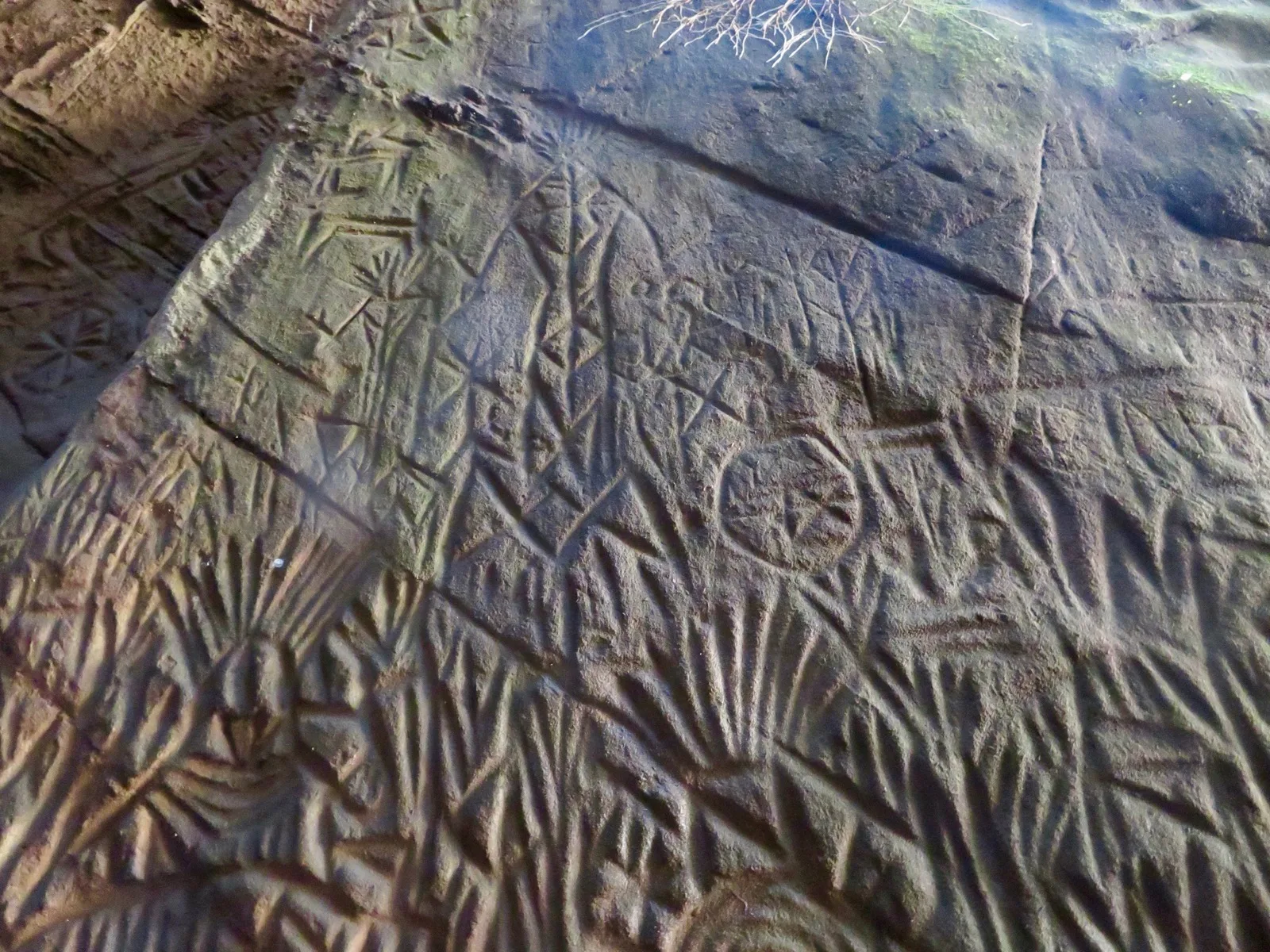
Edakkal is one stop on most Wayanad itineraries that actually lives up to the photos. A narrow natural cleft in the rock holds carvings thousands of years old. The valley opens up beneath you by the time you reach the top.
It Isn't Really a Cave
Nothing was hollowed out here, and no river carved it. A slab of rock split away from the body of Ambukuthi Hill and left a fissure behind, and at some point a separate boulder fell across the gap and settled there like a lid. That's the whole of it. The name is more accurate than the English one: edakkal means roughly "a stone in between."
The cleft runs about 96 feet long and 22 feet wide, and drops more than 30 feet. It sits around 1,200 metres up. Which means the view back down over the valley is worth the climb whether or not the carvings interest you, and plenty of people who come for the carvings end up remembering the view.
What You're Actually Looking At
The marks on the rock are petroglyphs, cut into the stone, not painted onto it. That distinction is worth holding onto, because it's the reason they're still here after several thousand monsoons in a shelter that's open to the weather on one side.
Most people arrive expecting stick figures and animals. There are those. There is also a lot more: crosses, triangles, tridents, squares, stars, wheels, spirals, plant shapes, pot-shaped objects. Some of the human figures have raised or spiked hair. Some look like they're wearing masks. Kerala Tourism describes three distinct sets of carvings, which is the clearest evidence that people came back to this rock across very different periods rather than in one go.
Be sceptical of anyone who hands you a single confident date. Published estimates put the oldest carvings at around 6,000 BCE, with activity continuing forward to roughly 1,000 BCE; Kerala Tourism describes some of the depictions as about 7,000 years old. That's a wide bracket, and the honest version is that nobody has closed it.
The site has later history layered on top. There's a Prakrit inscription connected to the Kadamba ruler Vishnuvarman, from around the fifth or sixth century CE, sharing a rock face with carvings thousands of years older than it. Edakkal came to wider notice in 1890, when Fred Fawcett, a police official in Malabar, worked out what he was looking at and wrote it up. And in 2009 the historian Raghava Varier identified a "man with jar cup" motif here that he connected to Indus Valley symbolism, a reading that drew serious attention and is still argued about. Treat it as an open question, not a fact.
One thing helps explain why anyone was up here at all. Ambukuthi sits close to an old trade route running between the highlands towards Mysore and the ports on the Malabar coast. This hill was not remote in its own time.
The Climb
The caves are about 10 kilometres from Sulthan Bathery, and roughly 45 minutes' drive from Cheeral Green. Vehicles stop partway up the hill; the rest is on foot, and allow about 45 minutes for it.
The first stretch is a made path with steps, climbing through coffee. Steady, unshaded in places, and relentlessly uphill. Then it changes character. The last section takes you up metal staircases fixed to the rock and through gaps that narrow to single file. Nothing technical, but there's exposure, and it slows to a queue when the site is busy.
Wear shoes with grip, not sandals. The rock holds damp long after rain stops. We'd be straight with you: this isn't a good outing for very young children, for anyone with knee trouble, or for anyone who dislikes heights or tight spaces. There's no shame in sending half the group up and waiting with a coffee at the bottom.
Timings, Tickets, and the Cap Nobody Mentions
The District Tourism Promotion Council lists the site as open roughly 8:30am to 4pm, closed on Mondays, with entry at ₹50 for adults and ₹30 for children and a separate fee for professional photography. Tickets are sold at the counter on the day (there's no online booking), so carry cash.
Here's the part that catches people out. There's a cap on how many people go up each day, listed by DTPC at 1,920. On weekends and through the December–January rush, that cap can be reached before the afternoon. Turning up at two o'clock on a Sunday in peak season is a real way to drive home without seeing anything.
Timings and fees do change. Ask us the week before you travel and we'll check where things stand rather than guess.
Go Early. We Mean It.
This is the one thing we'd insist on, and the daily cap is only part of the reason.
The final approach is narrow, so a crowd doesn't spread out. It stacks up on the staircases. The sun gets strong on the open sections well before midday. And low morning light rakes across the rock and throws the carvings into relief, which is the difference between seeing them and squinting at them. By eleven the light is flat and half of it disappears.
What to Take With You
- •Closed shoes with grip. The single most useful thing on this list.
- •More water than you think. There are shops near the base and fewer as you climb.
- •Cash for tickets and parking.
- •A small bag you can wear. You'll want both hands free on the staircases.
- •A hat. Much of the walk is open to the sky.
Two Mistakes Worth Avoiding
The first is treating Edakkal as a quick stop. Guests routinely give it forty minutes and then find themselves rushing. Budget two and a half to three hours from the car park and back. The walk is most of it.
The second is saving it for the last morning. Between the Monday closure, the 4pm cut-off and the daily cap, Edakkal has more ways to go wrong than anywhere else on a Wayanad itinerary. Put it early in the trip so you still have a second chance.
Do You Need a Guide?
Not to find the place or to get up it. Where a guide earns their fee is the rock face itself. A lot of the fainter motifs are easy to walk straight past, and once someone points out the first few you start seeing them everywhere. A good one will also tell you plainly what's known and what's still being argued over.
Pair It With the Jain Temple
The Jain temple at Sulthan Bathery is close enough to fold into the same half-day if you set out early. It's thought to date to around the thirteenth century, built in the Vijayanagara style, and the carved pillars are still standing.
It's also where the town's odd name comes from. During the Mysore invasion of Malabar, the army used the temple as a store for ammunition, a battery. "Sultan's Battery" turned into Sulthan Bathery in British records, and it stuck.
Both are on the way back toward Cheeral Green, so it's one loop rather than two trips. If you want the wider plan, our local's guide to Wayanad lays out a few days that work.
Before You Go
Tell us which morning you're thinking of and we'll help you leave at the right hour, sort the transport, and check the site is open that day. It's a five-minute conversation and it saves a wasted drive.