
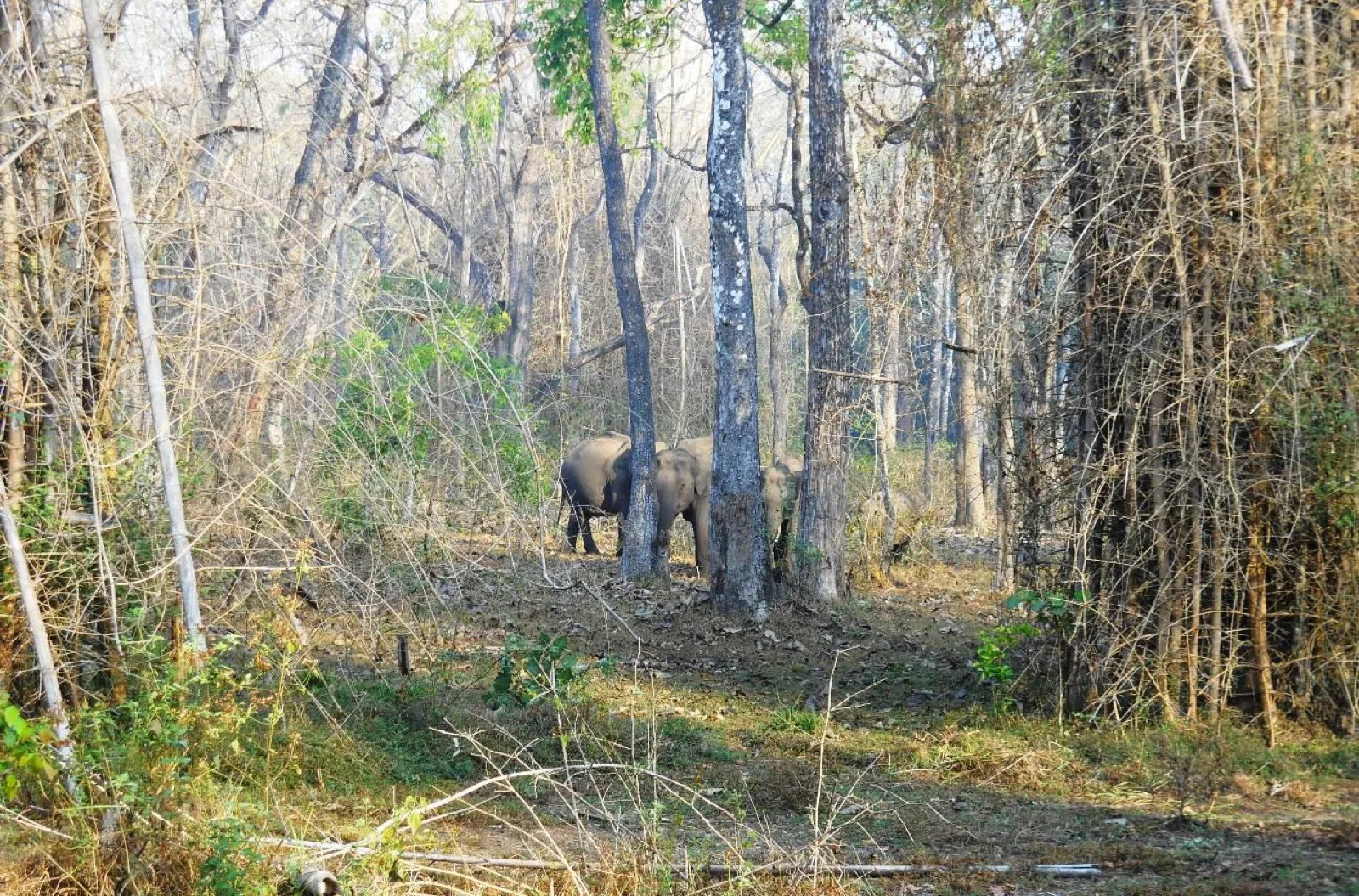
Muthanga is the wildlife sanctuary most guests ask us about first. It's worth setting expectations before you go. It's a real forest, not a zoo, and the animals operate on their own schedule.
Muthanga Is a Range, Not a Sanctuary
Small correction that changes how you think about the place. Muthanga is one range of the Wayanad Wildlife Sanctuary, which was set up in 1973 and covers roughly 344 square kilometres. Sulthan Bathery, Kurichiat and Tholpetty are the others.
And the sanctuary itself is a piece of something much larger. It sits inside the Nilgiri Biosphere Reserve and runs continuously into Bandipur and Nagarhole across the Karnataka line and Mudumalai in Tamil Nadu. Nothing is fenced at those borders.
Which is the real answer to why elephants turn up here as often as they do. You're sitting in one of the better-used elephant corridors in southern India, watching animals pass through on a route that has nothing to do with state boundaries or safari timings.
The forest is mostly moist deciduous teak with semi-evergreen patches: tall, fairly open, broken up by grassy clearings. Practically, that means you can see further into it than you can in dense evergreen forest, which works in your favour.
Booking It
The Kerala Forest Department runs the safaris and their vehicles are the only way in. You can't take your own car through, and there's no walking route. That's not a formality. It's a working sanctuary with elephants in it.
Trips go out in two windows, roughly 7am to 10am and about 3pm to 5pm, and a safari runs around ninety minutes. Be at the counter at least half an hour before your slot. In season the day's vehicles get allocated quickly and there's no holding a place by arriving late.
The cost is low by Indian wildlife-tourism standards: a small entry ticket each, plus a charge for the jeep that the group splits. Rates and booking arrangements do get revised, so ask us and we'll check where things stand before you fix a date.
The Tiger Question
We'll answer it before you ask. Yes, there are tigers, and leopards too. Yes, people see them. No, you probably won't.
What you're likely to see is elephants, spotted deer, sambar, gaur, wild boar, langur and macaques, and birds: peafowl, jungle fowl, woodpeckers, owls, and a long tail of things a birder would be much better placed to name than we are. That's a good morning. It just isn't the morning the brochures sell.
The guests who come back happiest are the ones who booked ninety minutes in old teak forest and counted the elephants as luck. The ones who booked a tiger tend to spend the whole drive waiting instead of looking.
When to Go
October to March is the comfortable stretch: cool mornings, dry tracks, pleasant conditions in an open jeep. It's also the busiest, so settle your dates early.
April and May are hot, dusty, and the forest looks worn out. They're also, awkwardly, often the better months for actually seeing things. Water gets scarce, so animals concentrate around what's left, and the undergrowth has thinned. If sightings matter more to you than comfort, that's the trade.
Through the monsoon, June to August, safaris at Muthanga and Tholpetty are commonly suspended. Don't build a trip around a July safari. Plan something else and treat it as a bonus if the forest department happens to be running. Closure dates are set locally and move year to year, so we'll check before you book.
Morning or Afternoon
Take the morning if you can get it. Cooler, quieter, animals more active before the heat, and better light for photographs. But don't treat the afternoon as a consolation prize. Animals come down to water in the last hours of daylight, and the 3pm slot has its own case.
Muthanga or Tholpetty?
Same sanctuary, both running jeep safaris. Muthanga is over on the Sulthan Bathery side and gets more visitors. Tholpetty is further north towards Mananthavady and the Karnataka border: quieter, and a longer drive from most of Wayanad. Staying with us, Muthanga is the sensible half-day.
What to Take
- •Dull colours: greens, browns, greys. White and bright shirts read from a long way off in open forest.
- •A warm layer for the 7am slot. An open jeep in December is colder than people expect of Kerala.
- •Binoculars, if you own a pair. Most of what you'll see is at distance, and most of it is birds.
- •A zoom lens if photos matter. A phone will not reach a deer across a clearing, whatever the marketing says.
- •Cash for the counter.
Once You're Inside
Stay in the vehicle. Keep your voice down. Noise is the most common reason a jeep comes back having seen nothing. Don't feed anything, and take your bottle home with you.
Elephants get particular respect. If your driver backs away from one, that's judgement rather than nerves, and it isn't a conversation to have in the moment. A cow with a calf on the track is a situation to leave, not to photograph for another two minutes.
Fitting It Into a Day
Muthanga is on the Sulthan Bathery side, so it pairs naturally with the Edakkal Caves or the Jain temple in town. A safari plus one other stop makes a comfortable day. Three stops makes a day spent in the car.
Before You Go
Pick your safari date early and tell us. We'll build the rest of the day around the slot and check the sanctuary is open, rather than you turning up and hoping.